Gaudiya Vaishnava Philosophy
ON ACQUIRING KNOWLEDGE
A philosopher will first ask, "What is the means to know?" In studying this perennial question, the philosophers have categorized all methods of attaining knowledge into three basic categories:
(1) Pratyaksa (sense perception): The knowledge directly perceived by the five sense organs and the mind is known as pratyaksa. The knowledge perceived through the senses can never be fully relied upon due to our inherent human defects. Our senses are limited by time and space, and our mind is biased by various desires. We do not see things very far or very near, and we may see things which hold no substance in reality, such as a mirage or a magician's show -- we mistake it to be something it is not, and we are confused over the reality of the matter. Even the reality of a mundane object can not be known with certainty through the means of sensory perception. How could transcendence then be proven through our material senses?
(2) Anumana (reasoning): Knowledge inferred from our observations is known as anumana. For example, we have seen smoke and fire together. When we observe smoke rising from behind a mountain, we reason there is fire. However, we may have mistaken a cloud for smoke, or a rain cloud may have already extinguished the fire, leaving only the smoke behind, and therefore our conclusion is false. If the reason is mistakenly understood, or there is an exception in the principle, our conclusion will be false. Therefore, reasoning is not an infallible means of acquiring knowledge. Moreover, being limited to our experiences in this world, reasoning lacks a capacity to reach into the specifics of transcendence with any degree of certainty.
(3) Shabda (revealed knowledge): For knowledge to be beyond human limitations, it must descend from beyond the human plane. The scriptures are understood to be apauruseya, or of divine origin. The writings of the sages are born of divine revelation, consisting of knowledge handed down by God, which is then passed on and preserved over the generations to provide an adequate means of insight into the transcendence. Naturally, for accepting the evidence of scripture, an initial leap of faith is required -- but is this not the same in accepting any lesson from anyone? Initial faith is certainly required before understanding literature on any given subject matter, in order to facilitate study and to eventually progress to a stage of personal realization and divine insight.
The Gaudiya school accepts a threefold division of revealed knowledge, namely (1) shastra -- the considerations of the scripture, (2) sadhu -- the considerations of the saints, and (3) guru -- the considerations of one's own guru. There is a relation of interdependence between the three. The guru is a representative of scriptures and the predecessor saints, the saints' teachings must be in harmony with the teachings of scripture and understood with the help of the guru, and the various scriptural statements are properly understood through the teachings of the saints and the guru. If the testimony of one of them is not compatible with the other two, it is not to be accepted as conclusive.
That being said, we may legitimately ask: Why should there be any defect in the scripture, since it is said to originate from God? The scripture itself answers the question: The vast body of Vedic literature is compared to a wish-fulfilling tree offering fruits of choice to one and all to facilitate their spiritual growth according to their inclinations in any given situation of life. What is a valid advice for one may be contrary to the progress of another. Consequently, a tradition of saints and a realized guru who teaches the scripture in a relevant way is necessary for obtaining valid knowledge of that which is beyond the range of sensory perception.
ESSENTIAL CATEGORIES
To begin with, we should determine that which is to be understood. In examining the nature of existence, we divide philosophy into three basic categories:
(1) Sambandha (relationship) -- the nature of and relationships between the individual living entity and the Supreme;
(2) Abhidheya (method of attainment) -- the proper course of action in accordance with the aforementioned understanding;
(3) Prayojana (ultimate perfection) -- the ultimate goal and purpose of the living entity in relation with the Supreme.
Let us reflect on these concepts and their various constituents.
SAMBANDHA -- RELATIONSHIP
There are two fundamental factors in existence: (1) The living entities, who have an eternal relationship with (2) the Supreme Person.
(1) The living entities -- The living entity, an eternal spiritual being, is encaged within a world of matter since beginningless time. On account of ignorance of its essential nature, the eternal living entity identifies itself with various attributes of this world life after life. From childhood to youth, from youth to old age, from old age to death and again to a new birth in accordance with its desires and deeds, the living entity wanders in this world.
Sometimes thinking of himself as a male, sometimes a female, sometimes an American, sometimes an Indian, and sometimes a camel or an ass, the living entity meets happiness and distress among various species of life, birth after birth. Longing to satisfy its unfulfilled desires, the living entity roams about in this world in an endless quest for love and happiness, never to be satisfied. That which is of spirit in nature will never find its peace in a world made of matter.
(2) The Supreme Person -- The Supreme Person is the ultimate manifestation of the Absolute Truth, the original cause of all creation, maintenance and destruction. He is simultaneously transcendent and immanent, being beyond the influence of this world, yet eternally aware of everything therein. Whatever exists in all the material and spiritual worlds consists of Him and His infinite energies only. His various energies are divided in three basic categories:
(1) External energy -- His external energy consists of the material world. This energy is divided into eight basic elements, namely five gross elements, and three subtle elements. They are (1) Earth, or all that is solid, (2) Water, or all that is liquid, (3) Fire, or all energy, (4) Air, or all aeriform substance, (5) Ether, or the space in which everything exists, (6) Mind, or the emotional faculty of the psyche, (7) Intelligence, or the discriminating faculty of the psyche, and (8) False ego, or the faculty of the psyche which forms a mundane conception of personality. This combination of elements known as the material world is temporary in nature.
(2) Marginal energy -- His marginal energy consists of the living entities of this world, the tiny spiritual sparks which are situated in a marginal position between the material world and the spiritual world, having the possibility of choosing between the two in accordance with their desires. The living entities are simultaneously one with and different from the Supreme, just as a ray of sun is one with and different from its origin, the sun.
(3) Internal energy -- His internal energy consists of sandhini (eternity), samvit (consciousness) and hladini (ecstacy), forming the basis of existence in the spiritual world. The feature of eternity is the ingredient of which all spiritual worlds consists, the feature of consciousness is the ingredient from which varieties of awareness arise, and the feature of ecstacy is the ingredient from which divine, blissful loving emotions arise.
The nature of the Supreme Person is discussed in depth in our [theology] page. Having clarified the theoretical basis of everything, let us examine the functional basics for existence.
ABHIDHEYA -- MEANS OF ATTAINMENT
In accordance with their insight or lack thereof, the living entities of this world are engaged in various pursuits. Some are engaged in attempts to produce bodily and mental comfort for theirselves, for the society or for the world at large. However, since we are living in a temporary world, nothing of a permanent nature can be achieved by such endeavors.
Others are engaged in a pursuit for wisdom to negate the joys and grieves of the temporal world, longing for salvation or emancipation. However, in lack of a positive spiritual alternative, how could the individual spiritual being attain the fulfillment of its eternal, individual desires?
The path of bhakti, of loving devotional service to the Supreme Person, is known as the path for attainging the ultimate good. Prayojana, or the ultimate perfection for the living entity, is known as pure, unnalloyed, ecstatic love for the Supreme Person. The path for attaining bhakti is called "sadhana", or "that which leads to the goal".
There are two paths of bhakti in practice -- (1) vaidhi-bhakti, and (2) raganuga-bhakti. They are understood as follows:
(1) Vaidhi-bhakti (devotional practice of rules and regulations) -- When one hears from the saints about the scriptural statements on the duty of all living entities is to serve and worship the Lord, a feeling of obligation and reverence may awaken within the heart. When such a conception acts as the impetus for his pursuing the path of bhakti, his path is called vaidhi-bhakti, or devotional practice following in the wake of scriptural injunctions.
(2) Raganuga-bhakti (devotional practice in search of loving attraction) -- When one hears from the saints about the sweetness of the Lord's pastimes with His associates, a sacred greed for obtaining loving feelings similar to one of His associates may awaken within the heart. When such a conception acts as the impetus for his pursuing the path of bhakti, his path is called raganuga-bhakti, or devotional practice in the wake of loving attachment.
These two paths lead the aspirants to two different goals in the spiritual world. The practice of vaidhi-bhakti leads the aspirant to Vaikuntha, where a sense of awe and reverence towards the Lord prevails, whereas raganuga-bhakti leads the aspirant to Vraja, where natural loving feelings are prominent.
Externally the practices of the sadhaka (practitioner) on both paths look similar. The difference is in the inner motivation. Various practices of sadhana will be discussed in a separate essay on the [practices] page. Let us now examine the gradual ninefold evolution of the aspirant from the beginning of his journey to the perfection of ecstatic love of God.
(1) Sraddha (faith) -- In the beginning, there is faith in the scriptures describing bhakti. This faith arises from contact with saints. In one person faith appears spontaneously, and in another it appears as the result of resolving doubts and misconceptions about the scriptures and the words of the saints.
(2) Sadhu-sanga (association of saints) -- After attaining faith, one naturally seeks the shelter of a spiritual teacher (guru), and inquires from him and receives initiation into the various practices of devotion. Then one receives the fortune of associating with soft-hearted, realized saints who are endowed with similar spiritual aspirations.
(3) Bhajana-kriya (engagement in worship) -- In the course of engaging in various devotional practices, one will undergo various phases in progressing from unsteadiness to steady practices. One will meet with initial enthusiasm, oscillating attention and slackness, indecision, struggling with the uncontrolled senses, inability to uphold vows, and straying after the by-products of advancement arising from the admiration of others, such as profit, fame and adoration.
(4) Anartha-nivritti (cessation of unwanted elements) -- In the course of devotional practices, one will become purified of "anartha", or various undesirable elements which obstruct devotion. They are known as (1) anartha arising from sinful works, (2) anartha arising from pious works, (3) anartha arising from offences, and (4) anartha arising from devotion. These four cause the following obstacles: (1) ignorance, false egotism, attachment, hatred, and entanglement in bodily enjoyment, (2) affection for the pleasures of this world obtained as the fruit of good works, (3) lack of taste, love and affection for the Lord and His name, and (4) various by-products of bhakti, such as profit, fame and adoration, which may lead one astray. By the power of devotional practice, all of the aforementioned unwanted elements will gradually be destroyed.
(5) Nistha (steadiness) -- After overcoming laziness, distraction, inability to engage in devotional practices despite being in a suitable situation, attachment to old bad habits, and the influence of sensual pleasures, one comes to a stage of steadiness in practice. At this point, no obstacles can waver him from his determined practice of devotion.
(6) Ruci (taste) -- The treasure of bhakti illuminated by the fire of devotional practices gives rise to a special taste for all aspects of practice, such as chanting the holy names, hearing the pastimes of Krishna and so on. At this stage, the sadhaka never feels the slightest fatique even by repeated hearing and chanting. This taste gives rise to his intense absorption in the same.
(7) Asakti (attachment) -- When one's taste becomes very thick and mature, one arrives to the stage of attachment. In the stage of ruci, engagement in devotion is the dominant object of taste, but in the stage of asakti, the Lord Himself becomes the dominant object of taste. In the stage of ruci, some effort is required for focusing the mind on the Lord, but in the stage of asakti, this paramount absorption comes about naturally and without separate endeavours.
(8) Bhava (intense emotion) -- Asakti in its extreme maturity is known as bhava, or intense emotion. At this stage, the naturally soft heart of the aspirant melts like butter or honey scorched by the rays of the sun, an unquenchable yearning for meeting the Lord is ever-present in his heart, and he is plunged into a whirlpool of loving emotions. At this point, he attains complete identification with his perfect spiritual form (siddha-deha) in which he has longed to serve the Lord.
(9) Prema (ecstatic love) -- Finally the loving aspirant obtains the fruit of prema, and tastes the joint experience of all divine emotions known as bhakti-rasa or sacred rapture. This prema within the heart of the devotee becomes like a powerful magnet attracting the dark iron-like Krishna. Eventually the Lord reveals to him His most auspicious qualities like beauty, nice odour, sweet voice, His tenderness, nice taste, generosity and compassion, overwhelming all of his senses. All these attributes are most sweet and eternally fresh, and when the devotee begins to relish them with love, this relish increases within his heart at every moment. This causes a powerful eagerness and finally creates an ocean of ecstacy which no poet could properly describe.
The perfection of all devotional endeavours is further described in the following section.
PRAYOJANA -- ULTIMATE PERFECTION
The Lord, while eternally residing in His divine abode in the world beyond, also eternally displays His pastimes in this world, moving about from one universe to another to bless the souls of this world with the nectar of His pastimes. The pastimes of the Lord in the spiritual world are called His unmanifest pastimes, and the pastimes in this world are called His manifest pastimes.
As the aspirant reaches the stage of ecstatic love (prema), attaining direct vision of his beloved Lord, his journey for perfection in this world is completed. As he departs from this world, he is taken to the universe where the Lord displays His pastimes at that time. He takes birth from the womb of a gopi (divine cowherd lady) in the village of Krishna, attaining a spiritual body suitable for further expressions of divine love.
During that life, he or she (depending on the kind of relationship the aspirant has longed for) spends her time with the eternally perfected associates of the Lord who have descended with Him from the unmanifest world, and is acquainted with life in the spiritual world, gradually mastering the expression of all divine emotions. Then, at the end of the Lord's manifest pastimes, she is transferred to the eternal, unmanifest pastimes of the Lord in the spiritual abode.
Now, let us examine the concept of bhakti-rasa, the collective expression of divine love, according to its different constituents, known to be of five kinds.
(1) Sthayi-bhava (permanent emotion) -- Sthayi-bhava is the basis of experiencing bhakti-rasa, and it has five prominent varieties: (1) neutrality, (2) servitude, (3) friendship, (4) parental love, and (5) amorous love. Click here for a more elaborate description of sthayi-bhava.
(2) Vibhava (provoking emotion) -- Vibhava is known to be that which inspires the experience of sthayi-bhava, and is of two varieties, (1) the persons who provoke the exchange of emotions, namely the object of love, Krishna, and the reservoir of love, the devotee, and (2) items connected with Krishna.
(3) Anubhava (consequent emotion) -- Anubhavas are expressions of emotion such as crying, laughing and singing, which naturally follow in the wake of the primary emotion.
(4) Sattvika-bhava (ecstatic emotion) -- Sattvika-bhavas are powerful ecstatic emotions which arise in the devotee without any conscious intention when he is overwhelmed with blissful love. Becoming stunned, fainting and faltering of voice are examples of sattvika-bhava.
(5) Vyabhicari-bhava (surging emotion) -- Vyabhicari-bhavas are surging emotions, which appear on the foundation of sthayi-bhava just as waves rise and fall in the ocean. Excitement, shyness and jubilation are examples of vyabhicari-bhava.
The collective experience of these five emotions is known as bhakti-rasa, or the sacred rapture of devotion. Bhakti-rasa is a complete expression of exquisite love of God, the ultimate goal for all living entities. Initial experience of bhakti-rasa takes place already in this world, but the fullest extent of expression is only possible in a spiritual body of an associate of the Lord in His abode.
This divine abode is described in the ancient words of the Brahma Samhita:
"I worship the divine abode of Goloka, which is rarely reached by the sages of this world. There Sri Krishna, the supreme lover and enjoyer, sports with His divine beloveds. There every tree is a desire tree, the soil consists of wish-fulfilling desire gems, and the water in the rivers and lakes is made of nectar.
In this world, every word is a song, every step is a dance, and the flute is always the Lord's dear companion. Everything is permeated with supreme effulgence of cognizance and bliss, and an ocean of milk flows from the divine surabhi-cows of the Lord. There time certainly does not pass away for even a splinter second, since it is eternally beyond the deteoriating influence of time."
The Lord's abode is further revealed in the prayers of Raghunatha Das Gosvami:
"I take shelter of the pasture fields of Vraja, where even today Krishna, His brother, and His dearest friends are engaged in their pastimes of herding the cows with great affection. The indescribable sweetness of Vraja is manifest in the hearts and minds of the sensitive devotees who are conversant with the mellows of devotion.
I worship the most enchanting abode of Sri Vrindavana, which is made fragrant by the lotus feet of the adolescent Divine Couple, Radha and Krishna, who are surrounded by many laughing and joking girlfriends, who are very expert all varieties of arts of the amorous play. In Vrindavana, the Divine Couple passionately sports day and night in the forest groves surrounded by trees, vines and fresh leaves, as well as in the caves of its mountains."
Thus we conclude our discussion on the philosophical precepts behind the Gaudiya Vaishnava tradition, having described the conceptions of the living entities' relationship with the Supreme Person, the supreme goal of life, and the process for its attainment.
Gaudiya Vaishnava Practice
A profound conception of divine truths naturally leads one to adopt various practices in obtaining the desired goal of life. While faith in the precepts of the tradition is certainly desirable, it is not sufficient in itself. There must be a method of practically realizing the truth of the object of our faith. This method is collectively called "sadhana", the means of attainment.
In the Gaudiya Vaishnava tradition, the essential outline for all practices is presented as follows by Rupa Gosvami in his Bhakti Rasamrita Sindhu, which is one of the core texts for the tradition:
"One should remember Krishna along with His dear eternal associates of one's own preference. With attachment to discussions about them, one should always live in Vraja."
"One should serve both in his physical body and in his internally conceived spiritual body, following in the footsteps of the residents of Vraja, desiring to obtain a mood similar to theirs."
"On the path of raganuga-bhakti, one should also adopt the limbs of vaidhi-bhakti, such as hearing about Krishna and glorifying Him. Thus the great sages have concluded."
The object of practice, as is evident from the above, is to attain a position similar one to the eternal associates of Krishna in the realm of Vraja, the pinnacle of the spiritual world, thus exquisitely serving the Supreme Person with all of one's loving feelings.
PRELIMINARY INSTRUCTIONS
In Upadesamrita (Nectarine Instructions), Rupa Gosvami delineates six items detrimental for devotion and six items conducive for devotion, which are to be deeply considered and adopted by all sincere aspirants.
Six items detrimental to the development of devotion are as follows: (1) eating too much or collecting more than necessary, (2) endeavours which are opposed to bhakti, (3) useless mundane talks, (4) failure to adopt essential regulations or fanatical adherence to regulations, (5) association with persons who are opposed to bhakti, and (6) ardent longing for the mundane.
Six items favorable for the development of devotion are as follows: (1) enthusiasm, (2) firm faith, (3) patience and fortitude even amidst obstacles, (4) performance of proper activities, (5) giving up undesirable association, and (6) molding one's life similar to that of earlier saints.
TWO VARIETIES OF PRACTICE
The practices are divided into two main categories, which are as follows:
(1) Service in the physical body -- In his physical body, the aspirant follows in the footsteps of the great teachers of the past, engaging in various activities such as associating with saints, chanting the holy names, hearing discourses about the philosophy and the pastimes of Sri Krishna and His beloved associates, worshiping the Deity form of the Lord on the altar, and residing in a holy place. This will be elaborated upon later on in this presentation.
(2) Service in the internally conceived body -- In his internally conceived spiritual body, which is suitable for rendering particular services to the Divine Couple, the aspirant engages in the practice of smarana, rememembrance. This service has two phases, namely static meditation and dynamic meditation. They are understood as follows:
(1) Mantramayi-upasana (static meditiation) -- The aspirant meditates on the Divine Couple seated in the midst of yogapitha (seat of union) formed in the shape of an eight-petaled lotus. The Divine Couple are surrounded by Their confidantes, namely the eight sakhis (girl-friends), who are located on the inner eight petals of the lotus, and the eight manjaris (maidservants) who are located on the next eight petals of the lotus. Following his guru who has assumed a form similar to the confidantes of the Divine couple, the aspirant renders various services to everyone in his own internal guru-given form of a maidservant.
(2) Svarasiki-upasana (dynamic meditation) -- The aspirant meditates on the eight-fold daily pastimes of the Divine Couple, rendering various services which have been assigned to him (her) by the guru, and which are appropriate for the ongoing pastime. An outline of the eight-fold daily pastimes of the Divine Couple can be viewed here. Generally the meditation on the daily pastimes of Radha-Krishna is preceded by a shorter contemplation on the corresponding daily pastimes of Sri Chaitanya, who is understood to Krishna Himself in the form of His devotee. An outline of His daily pastimes can be viewed here.
The practices of the aspirant naturally begin with the services performed with the physical body. In the course of time, as his understanding and ability of concentration increase, the internal practices become more and more prominent. However, the two are never to be separated from each other. They are to be adopted in a relationship of interdependence, where progress in one nourishes the other.
PROMINENT ASPECTS OF PRACTICE
The practices undertaken with the physical body will naturally be the prominent side of practice in the eyes of the world. Moreover, the internal, esoteric practices are not the subject matter of elaborate public discourses. Therefore, we shall focus on the external practices, which are of paramount importance in attaining genuine internal absorption in love of God.
In his Bhakti Rasamrita Sindhu, Rupa Gosvami has divided the various practices of bhakti in sixty-four categories, beginning with accepting a spiritual teacher (guru), receiving initiation and instructions from him, serving him, living a life following in the footsteps of the saints, and inquiring about matters of worship (bhajana). An extensive discourse on this matter is not in place in this context, so we shall only focus on five of them, which were declared as the most important by Sri Chaitanya.
(1) Sadhu-sanga
(Associating with Saints)
In the scriptures, association with saints is declared to be the root cause of love and devotion to the Lord. In the association of saints, all aspects of devotional service become perfected. They are a living example of a practical life of devotion.
One should render service to saints and offer them items they need, and lovingly accept whatever they offer in turn. One should reveal his mind to them in confidence, and carefully hear their realized instructions. One should feed them and accept their remnants with respect and devotion as a form of their grace.
Anyone who has taken up the path of spiritual life is certainly a saintly person. However, to reap the full benefit of association, one has to discriminate between devotees of different grades. One should respect in his mind everyone who is inclined towads spiritual life, one should offer respects to and make friends with the one who is initiated and firm in his devotion, and one should lovingly serve the one who is realized in exclusive devotional worship of the Lord and whose heart is completely pure from the tendency to defame others and so on.
Moreover, since there are certainly saints in many traditions, one should seek the association of those who are endowed with a similar inclination on the path of devotion. One should always seek the association of such saints who are affectionate towards oneself and more advanced than oneself. On the merit of such association, all spiritual practices will rapidly yield the fruit of love of God.
(2) Nama-kirtana
(Chanting the Holy Names)
The holy name of the Lord is nondifferent from His own form, qualities and pastimes. Therefore the chanting of the holy names is considered an integral part of practice in the Gaudiya tradition. hanting of the holy names is known to be of two kinds, namely "japa" and "kirtana".
Japa -- Japa is individual meditation on the holy name, during which the aspirant quietly murmurs the holy names while keeping count on a mala (rosary) of 108 beads. According to the instructions of Sri Chaitanya, Gaudiya Vaishnavas chant the maha-mantra (great mantra) which is as follows:
Hare Krishna Hare Krishna
Krishna Krishna Hare Hare
Hare Rama Hare Rama
Rama Rama Hare Hare
This mantra consists of three divine names, namely Hara, Krishna and Rama. Hara, which becomes Hare in its vocative case, refers to She who steals the mind of Krishna, in other words Radha. Krishna refers to the all-attractive original person. Rama is another name for Him, meaning the one who brings delight to Radha and who enjoys varieties of transcendental sports.
In addition to the maha-mantra, panca-tattva mantra is often chanted prior to it. Panca-tattva mantra consists of the names of Sri Chaitanya and His four associates, namely Nityananda, Advaita, Gadadhara and Srivasa, along with "Gaura-bhakta-vrinda" (all devotees of Sri Chaitanya). There are slight variations for this mantra from lineage to lineage, but the basic pattern is the same.
Practitioners chant the holy name according to their capacity, completing a fixed number of names for each day. Sri Chaitanya recommended His followers to chant one lakha (100.000 names), which corresponds to some 64 rounds on the rosary. The counting of malas (rounds on the rosary) is done with a separate string of beads consisting of 16 small beads on one side and four on the other, meant for counting individual rounds and sets of 16 rounds respectively. The specific number of holy names to be completed each day is largely individual, and varies from a few hundred names to hundreds and thousands of names. It is common for dedicated saints to chant 100.000, 200.000 or 300.000 holy names (64, 128 and 192 rounds on rosary) per day.
As the eagerness and insight of the aspirant increases, the holy name reveals Himself proportionately unto him, eventually unfolding the entire world of divine reality along with the daily pastimes of the Divine Couple within the heart of the aspirant.
Kirtana -- Kirtana refers to the glorification of the holy names which is done aloud, often with the accompaniment of mridanga (clay drum) and karatalas (hand cymbals). When many faithful aspirants gather for loudly singing the holy names of the Lord, this is called sankirtana. Such kirtana is sometimes performed in the temples, and sometimes out on the streets in processions.
This sankirtana is understood to be the foremost among the sixty-four items of devotional practice. On account of its great ability for absorbing all senses in experiencing the sweetness of the Supreme Person, it is regarded as the most potent among all varieties of practice. Whereas many other practices depend on the lucidity of the practitioner's mind or on his ability of concentration, nama-sankirtana does not consider this, but instead plunges the aspirant in an ocean of divine happiness regardless of his qualification or lack thereof. During the modern age, it is understood that all devotional practices must be accompanied by nama-sankirtana to yield the fruit of pure loving devotion.
Sri Chaitanya glorified the paramount position of Krishna-sankirtana in the first stanza of His Siksastakam (Eight Instructions) as follows:
"May there be supreme victory for the congregational chanting of the names of Krishna! It cleanses the mirror of the heart, and extinguishes the great forest-fire of material existence. It is a great moon spreading its soothing rays, bringing to bloom the white lotus of good fortune of the living entitiy. The holy name is the life and soul of the young bride of divine wisdom, and an ever-increasing ocean of ecstacy, and by tasting it, the self becomes thoroughly cleansed, and comes to taste at every step the complete nectar it has always longed for."
The practice of nama-sankirtana is unequivocally recommended for one and all, since there are no hard and fast rules for it. It does not depend on time, place, person, articles of worship, purity or impurity. In whatever situation the holy names of the Lord are chanted, they prove to be beneficial for everyone.
(3) Bhagavat-sravana
(Hearing the Srimad Bhagavatam)
The scripture Srimad Bhagavata is known as the ripened fruit of the desire-tree of Vedic literatures. The study and hearing of the Bhagavata is essential for one who aspires to understand the science of approaching the Lord. The Bhagavata itself proclaims in its invocation:
"O knowers of divine rapture, O saints of the world, O people filled with sacred emotions! Always relish the Srimad Bhagavatam, the fully ripened fruit of the desire tree of Vedic literatures, complete in all respects, which emanated from the lips of Sukadeva Gosvami like a gush of nectar, being the abode of rasa itself!"
Though all efforts of studying the Bhagavata are certainly beneficial, the most benefit will be gained by approaching a self-realized soul who is expert in understanding the intricacies of philosophy and divine love presented in the scripture. Such a saint is the living medium of divine wisdom, and has the ability to deepen our understanding of the words of the scripture.
There are ten primary subject matters delineated in the Bhagavata, which are as follows:
(1) Sarga -- The primary creation, a description on the Lord as the origin of the elements of this world;
(2) Visarga -- The secondary creation, a description of the constituents and creation of this world;
(3) Sthana -- Various abodes where the living entities dwell, among which teh spiritual world is supreme;
(4) Posana -- The protection and care of the Lord for those depending on Him;
(5) Uti -- The impetus for action, an analysis of the various dispositions of the living entities in this world;
(6) Manvantara -- Descriptions of the cosmic ages of Manu, histories from the past ages;
(7) Isanukatha --The various descents of the Lord and His activities together with His great devotees;
(8) Nirodha -- The eventual withdrawing of the cosmic manifestation by the Lord;
(9) Mukti -- Liberation from the bondage of matter and the attainment of one's constitutional nature;
(10) Asraya -- The ultimate shelter of everything, the ever-independent Supreme Person.
The Bhagavata reveals its profound philosophical and theological precepts in the course of narrating various histories describing the Lord and His devotees. A comprehensive study of the Srimad Bhagavatam enables the aspirant to understand his relationship with the Lord, the dynamics of such a relationship, and its ultimate goal.
It should be understood that the practice of hearing the Bhagavata also includes hearing and discussing literature following in the wake of the message of the Bhagavata. Over the centuries, innumerable saints and sages have elaborated on the original message of the Bhagavata in accordance with their divine insight, and the study and hearing of such writings is also most beneficial in deepening one's understanding and realization.
The Bhagavata itself describes the fruit of such hearing:
"The Supreme Lord rapidly manifests in the heart of one who faithfully endeavors to always hear the message of the Bhagavata. Through the holes of their ears, the Lord descends to the lotus of his heart, awakening his unique, natural disposition towards Him, and cleansing him from all mundane evils, such as lust, greed, anger and so forth, just as fresh autumnal rains clear the muddy pools of water."
There are innumerable beautiful writings describing the Lord's name, form, characteristics and pastimes with His beloved associates. Attentive hearing of such descriptions awakens a feeling of natural attraction towards the Lord and creates a powerful impetus for progressing on the journey for divine love for the Lord.
(4) Mathura-vasa
(Living in the Holy Land of Mathura)
When the Lord descends to this world with His eternal associates, His divine abode descends along with Him to serve as His playground in this world. This holy abode of the Lord manifest in the earthly realm is an exact replica of the celestial world in the realm beyond. Mathura Mandala and Vraja Mandala are two names for the sacred abode where Sri Krishna enacted His pastimes some 5000 years ago.
Though such a place may appear to us as just another territory in the mundane world, it appears as such only on account of our mundane vision. The imperfect beings of this world lack the eyes to see the divine world of the Lord, which is ever-permeated with love divine. However, in the course of practice our senses and mind are purified, which enables us to behold the divine realm of Vraja instead of its illusory covering manifest to our present eyes.
The various places around Vraja Mandala are a perfect impetus for invoking remembrance of the Lord's pastimes within the heart, and the association of saints living in such places, spending their time in absorption in thoughts of the Lord, can never fail to leave one empty-hearted. However blinded one may be, he can never escape the supramundane potency of such a holy place. For those unable to live in or visit places such as Vraja Mandala, it is advised that one should live there mentally by being absorbed in thoughts of the Lord's pastimes there.
The land of Vraja Mandala is divided in twelve forests, spreading over 84 krosas (168 square kilometers). They are collectively known as Vrindavana, or the forest of Vrinda, named after Vrinda Devi, the goddess presiding over the forests, making all varieties of delicate arrangements to perfect the loving pastimes of the Divine Couple. In his "Nectarine Instructions", Rupa Gosvami presents a hierarchy of divinity among the holy places within and outside the district of Vraja:
"The city of Mathura is superior to the spiritual world of Vaikuntha, since the Lord Himself appeared there. Superior to Mathura is the forest of Vrindavana, since Krishna displayed His pastime of rasa-lila (circle dance) there. Superior to Vrindavana is the Govardhana hill, which was lifted by the Lord Himself, and where He enacted numerous pastimes with His dear associates. However, above all is the lake known as Radha Kunda, since it is overflooded with the nectarine blissful loving plays of the Lord of Gokula. Where is that discriminating person who would not desire to serve this divine lake situated at the foot of Govardhana hill?"
Vraja Mandala is saturated with divine love, being the personal playground of the Lord, and therefore it is a most befitting place for an aspirant who desires to perfect his spontaneous loving propensity for the Divine Couple.
(5) Sri-murti-seva
(Serving the Worshipable Form of the Lord)
-- The transcendental form of the Lord is beyond the grasp of mundane sense perception. However, since there is a need for the practitioners to render concrete service for the Lord, in His kindness He assumes a form consisting of the elements of this world, visible to humans. Such a form of the Lord is called an arca-vigraha (form to be worshiped) or an arca-avatara (an incarnation for worship), commonly referred to as a deity-form of the Lord.
Faithful service to the deity of the Lord allows the aspirant to establish a personal relationship of service with the Lord by cooking for Him, preparing clothes for Him, singing for Him, arranging festivals in His celebration, offering incense and flowers unto Him, and so forth.
The deity forms of the Lord are of eight kinds: (1) Made of stone, (2) made of wood, (3) made of metal, (4) made of earth, (5) painted, (6) made of sand, (7) envisioned in the mind, and (8) made of jewels. After the completion of the deity form, the Lord is invoked into this form by a dear devotee of the Lord, a loving servant of His. Thus the Lord appears among the elements of this world to accept the loving service of His devotees.
In addition to facilitating the development of a personal relationship with the Lord, the process of arcana (deity worship) helps the practitioner to become clean and regulated on account of the various ceremonies to be observed in relation to serving the Lord. The maintenance of both external and internal purity is essential for securing sound progress on the path of spiritual life. The practice of deity worship is particularly essential for people who are living and working in the society, since it very tangibly ensures that the service of the Lord remains the centre of all endeavors. The deity forms of the Lord are often found in temples where people gather for worship, but it is equally common for devotees to have their own deity form whom they worship at home.
The most common deity forms worshiped in the Gaudiya tradition are the forms of Radha Krishna, who are installed on the altar side by side. Such service follows in the wake of the eternal maidservants of the Divine Couple, and facilitates the development of such a desired mood. Sometimes the forms of Sri Chaitanya and His brother Nityananda are installed on the altar and are served in their loving pastimes in the realm of Navadvipa. Though not as common as Nityananda, His dear associate Gadadhara is also seen on altars alongside with Him, and sometimes the complete pentatheon (Panca Tattva) of the Lord in His various aspects is worshiped.
The exact procedures of worship vary from lineage to lineage. The aspirant is acquainted with particular methods of worship at the time of diksa (initiation), when the guru conveys to him the mantras to be contemplated upon and to be used in his worship along with instructions on the same. The process of arcana also includes certain internal aspects of visualized worship of the Divine Couple to be conducted in addition to the outer worship.
Though some of the practices presented herein may appear rather demanding, it should be noted that everyone may adopt them according to their particular eligibility and evolve over time closer to perfection. There is certainly a long journey to be wandered in obtaining love of God, but a sincere practitioner will experience joy on every step in approaching the object of his aspirations.
Gaudiya Vaishnava Theology
THREE ASPECTS OF DIVINITY
Learned men understand the Divine to manifest in three aspects, which are known as His all-pervading formless aspect, His aspect as the Lord of the heart, and his aspect as the Supreme Person.
(1) Brahman (the All-pervading Spirit): The non-differentiated aspect of the Divine is known as Brahman. This all-pervading spiritual substance is known to be the support of all the worlds, and whatever exists is known to be of Brahman only in its various manifestations. Brahman is understood to be the halo of the Supreme Person.
(2) Paramatma (the Supreme Soul): The localized aspect of the Divine is known as Paramatma. Known as the Lord of the heart, this aspect of the Supreme has expanded within the hearts of all living entities, invoking inspiration, knowledge and forgetfulness in them. He is the silent witness in our hearts, the impartial overseer and permitter of everyone's activities, and the one who keeps the world turning in accordance with the deeds of all living entities. He is an expansion of the Supreme Person for the maintenance of the cosmic manifestation.
(3) Bhagavan (the Supreme Person): The ultimate aspect of the Divine is known as Bhagavan. He is simultaneously transcendent and immanent, being situated in His own divine realm and simultaneously pervading everything through His infinite manifestations. This Supreme Person is the ultimate master, friend, father, son and beloved of all living entities. In His kindness, He manifests to everyone in accordance with their desires to serve Him, while remaining at the same time in His supremely attractive form of Sri Krishna, in whom all beauty and love find its pinnacle.
DIFFERENT ASPECTS OF THE SUPREME PERSON
An ancient prayer in Brahma Samhita says, "I worship Govinda, the primeval Lord, whose non-dual, perfect and eternal forms are unlimited, who is the original ancient person, yet in his blossoming youth, and who is beyond access for the Vedas, but very near to those with a pure, devoted heart."
The original Supreme Person, Krishna, expands into various forms to fulfill various purposes within His creation. He is known as Svayam Bhagavan (the Supreme Person Himself) and Lila Purusottama (the Supreme Enjoyer of Pastimes). To taste the full variety of loving exchanges with His devotees, He manifests various forms in both the material and the spiritual worlds.
Within the spiritual world, the Lord manifests Himself in His original form, in multiple forms with identical characteristics (such as in the rasa-dance and in the palaces of Dvaraka), as well as in multiple forms with different moods and characteristics (such as His brother, Balarama), which include the unlimited four-armed Vishnu forms pervading the vast spiritual sky.
When the Lord manifests Himself in the material world, the form which He displays is called "avatara", or "descent", that which descends from the world beyond. These avataras are classified under several categories in accordance with Their purpose. The general purpose of the descents is told to be threefold, namely (1) to bring joy to His devotees, (2) to destroy wicked elements in the world, and (3) to re-establish the principles of religion. These avataras are classified as follows:
(1) Lila-avatara (pastime descents): These forms of the Lord have very distinct features, and they enact unparalleled activities in this world. Some of them are Ramacandra (the ideal king and ruler), Narasimha (half-man half-lion form who saved His devotee Prahlada), and Matsya (the fish-form who swam in the waters of devastation).
(2) Purusa-avatara (descent for creation): There are three forms of the Lord particularly meant for the maintenance of the cosmic manifestation. They are (1) Karanodakasayi Vishnu who manifests all the universes, (2) Garbhodakasayi Vishnu who presides in each universe, and (3) Ksirodakasayi Vishnu, who presides in the hearts of all living entities, and is also known as the Paramatma.
(3) Guna-avatara (descents for controlling the modes of nature): There are three forms of the Lord meant for controlling each of the three modes of nature, namely goodness, passion and ignorance. (1) Brahma, who is generally an empowered living entity, is in charge of the mode of passion, and takes care of creation. (2) Vishnu is in charge of the mode of goodness, and takes care of maintenance. (3) Shiva, who is a transformed form of the Lord, is in charge of the mode of ignorance, and takes care of destruction.
(4) Saktyavesa-avatara (descents endowed with potency): When the power of the Lord for fulfilling a particular purpose is bestowed to a living entity, he is known as a saktyavesa-avatara. The powers bestowed are the power to teach divine wisdom, the power to instill devotion into others, the power to rule the world, and the power to create, among others. They are further divided into those who are directly empowered by the Lord and those who manifest a reflection of the Lord's potency.
(5) Manvantara-avatara (descents for the era of Manu): There are fourteen Manus who rule the humanity during each cosmic day of Brahma, and during each era there is a form of the Lord who descends to this world. The Lord's fourteen descents are known as Yajna, Vibhu, Satyasena, Hari, Vaikuntha Ajita, Vamana, Sarvabhauma, Risabha, Visvaksena, Dharma, Sudharma, Yogesvara and Brihadbhanu. Additionally, each Manu is a descent of the Lord.
(6) Yuga-avatara (descents for the age): There is a form of the Lord who descends in each of the four ages in the cosmic cycle of time, known as Satya, Treta, Dvapara and Kali-yugas. The Lord descends to teach the method of religion relevant for the particular age.
Please view a diagram of these manifestations to get the complete picture.
VARIETIES OF LOVING EXCHANGE
Considering the various manifestations of the Supreme Person from the point of view of ontological truth, they are nondifferent from each other, being manifestations of the Lord. However, there are definite differences between His various manifestations in terms of the taste experienced in loving exchanges with Him.
Primary loving relationships with the Supreme Person are known to be five-fold, namely:
(1) Santa-rasa (neutrality): When love for the Supreme is experienced upon beholding His glory, without experiencing a particular impetus for engaging in His service, the relationship is known as santa-rasa.
(2) Dasya-rasa (servitude): When love for the Supreme Person is experienced either as the reverence and submission felt by a servant towards his master, or as the respect and esteem that a son feels for his father, the relationship is called dasya-rasa.
(3) Sakhya-rasa (friendship): When love for the Supreme Person is experienced with feelings of intimacy and equality, devoid of the sense of obligation felt by a servant, the relationship is called sakhya-rasa.
(4) Vatsalya-rasa (parental love): When love for the Supreme Person is experienced as His dependence upon the devotee's nourishing, blessing and looking after Him, the relationship is called vatsalya-rasa.
(5) Madhurya-rasa (amorous love): When love for the Supreme Person is experienced as feelings of amorous love, as experienced between the lover and the beloved, or between the husband and the wife, the relationship is called madhurya-rasa.
Each subsequent relationship has more attributes and an increased feeling of intimacy. To facilitate the compatible existence of various relationships with Him, the Lord manifests His different aspects in different regions of the spiritual sky.
GRADATIONS OF PERFECTION
The spiritual sky is understood as having multiple regions wherein the Supreme Person manifests His pastimes in the company of His loving devotees. The progressive supremacy of these spiritual regions is determined in accordance with the degree of intimacy of love.
To comprehend the hieararchy of the various regions, we need to accustom ourselves with two basic concepts: (1) aisvarya (supernatural might and opulence), and (2) madhurya (natural sweetness and intimacy).
(1) Aisvarya: The Lord's exhibition of supernatural might and opulence which causes a feeling of fearful awe and reverence in the heart of the devotee, is known as aisvarya.
(2) Madhurya: The abundant sweetness of human-like relationships with the Lord, which covers any considerations of His Godhood under the veil of loving intimacy, is known as madhurya.
The more intimate and independent of the status of the object of love the love is, the more complete it is understood to be. Therefore gradations of perfection among the Lord's various features are measured on the scale of the presence of madhurya.
The spiritual sky is known as "Vaikuntha". In the shining realm of Vaikuntha, in the midst of innumerable Vaikuntha-planets, there is a divine planet called Goloka, which is the pinnacle of the spiritual sky. Goloka is further divided into three main sections, namely Dvaraka, Mathura and Vraja. Let us examine them:
(1) Vaikuntha: In Vaikuntha, the Lord is present in His four-armed Vishnu-forms, manifesting His supernatural opulences. The devotees in Vaikuntha-region serve the Lord filled with awe and reverence. Here the Lord is known to be complete.
(2) Dvaraka and Mathura: In Dvaraka and Mathura, the mood of devotion is a mixture of alternating reverence and sweetness. Here the Lord is known to be more complete.
(3) Vraja: In Vraja, the mood of devotion is of pure sweetness, and even the Lord's display of unparalleled majesty does not diminish the natural love of His devotees. Here the Lord is known to be most complete.
When Sri Krishna descends to this world, He manifests three ages: (1) childhood, (2) boyhood, and (3) youth. The first period of five years is filled with pastimes of parental love, the second with pastimes of friendly love, and the third with pastimes of amorous love. This enchanting form saturated with carefree blossoming youth is considered to be the perfection of His being, and the most attractive among all of His forms.
Though the various forms of the Lord are analyzed and hierarchically presented, there is certainly no fault in any of them. They are all eternal, filled with knowledge and ecstacy, and perfect in their position of enabling His experience of the full spectrum of loving interaction.
THE DIVINE COUPLE
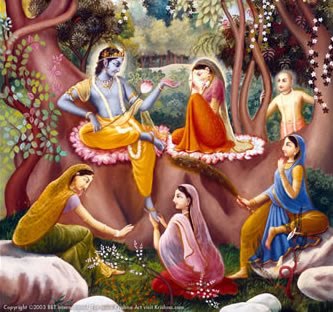
The divine counterpart of Sri Krishna is known as Sri Radha. Sri Radha is the complete energy, and Sri Krishna is the complete source of energy. They are nondifferent from each other, just as musk and its scent are inseparable, or as fire and its heat are nondifferent.
Just as Krishna expands Himself to Dvaraka and to Vaikuntha, so Radha expands along with Him to assume the forms of the Queens of Dvaraka and the Laksmi-goddesses of Vaikuntha. The cowherd maidens of Vraja are manifest from Her being to expand the relish of amorous adventures.
Radha and Krishna are one, yet They have assumed two separate forms to enjoy loving pastimes. She is Krishna's own divine potency who accompanies Him in His pleasure sports, being thoroughly imbued with and consisting of love for Him. Since Radha is filled with all divine qualities, She alone is able to fulfill all the desires of Krishna.
Poet Krishnadas Kaviraja has described the unparalleled beauty of the Divine Couple:
"May that Sri Krishna, son of the king of the cowherd men — whose effulgent bodily complexion defeats the luster of a fresh monsoon cloud, collyrium and sapphire, whose yellow cloth is more effulgent than kunkuma, the rising sun and a flash of lightning, and whose entire form is anointed with sandalwood paste mixed with camphor and saffron — bestow upon me the service of His lotus feet!
May that Srimati Radhika — whose bodily complexion snatches away the pride of a golden lotus flower tinged with kunkuma, whose bodily fragrance reproaches the fame of a fragrant lotus sprinkled with saffron powder, and who fulfills all the desires of the prince of Vraja, Sri Krishna — always bestow upon me the service of Her lotus feet!
May that Sri Krishna, son of the king of the cowherd men — who pleases Srimati Radhika and the cowherd maidens with the nectar of His pastimes in the forest groves and in the circle-dance, who nourishes them with His jokes and tricks, and who delights the hearts of everyone with His supernatural love, character, playfulness, and fame — bestow upon me the service of His lotus feet!
May that Srimati Radhika — whose softness defeats the fame of delicate budding flowers, whose body's coolness is worshipable for the moon, sandalwood-paste, the lotus, and camphor, and whose touch dispels the heat of Sri Krishna's amorous desires — always bestow upon me the service of Her lotus feet!"
In the wake of these prayers, Gaudiya Vaishnavas aspire to personally serve the Divine Couple in their amorous pastimes in the role of Sri Radha's manjaris (handmaids), assisting Them in various ways in the fulfillment of Their love.